

Short videos move the internet. Whether on TikTok, Instagram Reels, or YouTube Shorts, if a piece of content isn’t fast and eye-catching, it goes unnoticed. But editing long videos into clips is a tiring task – or rather, it was. With the advancement of artificial intelligence, AI Clips are changing the way creators, brands, and marketing teams transform lengthy videos into short, viral content. This trend crosses borders and is gaining traction in Brazil, driven by practical platforms like VDClip, which simplify the entire process.
What are AI Clips: the revolution of short videos with artificial intelligence
AI Clips are short, engaging, and optimized snippets of long videos, automatically generated by tools using artificial intelligence. There’s no need to make cuts, adjust subtitles, sync audio, or rethink formats manually: the technology does all this in seconds. The result? Small videos ready to captivate audiences on social media and increase the creator’s reach more easily and frequently.
Behind an AI Clip is a series of intelligent systems capable of analyzing complete videos using machine learning, computer vision, and natural language processing. These tools identify the most interesting moments, impactful phrases, the most expressive reactions, and even the visual details that engage the most.
This automation power democratizes content creation, as it eliminates the need for prior video editing experience. It makes it possible to transform any recording, whether podcast, live, webinar, tutorial, or lecture, into short clips ready to go viral.
Impactful scenes, dynamic subtitles, optimized formats: all done in minutes by artificial intelligence.
How does the technology behind AI Clips work?
The secret of AI Clips lies in the integration of three major fields of artificial intelligence:
- Machine learning: Advanced algorithms learn audience patterns, understand which speeches, reactions, and actions capture the most attention, and improve suggestions with each new processed video.
- Computer vision: AI identifies faces, movements, objects in the scene, transitions of emotion, and even facial expressions to focus the clips on visually striking moments.
- Natural language processing: The audio is transcribed, phrases with emphasis or repeated terms are detected. Impactful speech becomes a cut, spontaneous reactions receive subtitles, laughter marks high points.
All this processing is done in seconds, transforming long and complex videos into a series of “golden moments” ready to be published.
Another differentiator is the automation that goes beyond cuts: subtitles are generated automatically, already positioned and synced, possible translations are suggested, vertical or horizontal formats are adjusted according to the platform (TikTok, Instagram, YouTube Shorts), and even titles and hashtags can be strategically suggested.
Why have AI Clips become indispensable?
Digital habits have changed content consumption. According to data from IBGE, more than 87.6% of connected Brazilians watch videos online. But no one has time – or patience – for lengthy videos that don’t deliver value quickly.
 That’s why brands, creators, and even educators converting long videos into short clips gain an edge. AI Clips allow:
- Sharing viral cuts that engage immediately
- Extracting multiple content pieces from a single recording (saving time and effort)
- Quickly testing styles, formats, subtitles, and titles
- Reaching different audiences on various platforms with adapted versions
- Maintaining consistency in publishing quality content
For those who previously had no editing experience or time to cut videos manually, artificial intelligence in AI Clips has broadened horizons.
How do AI Clips transform the routines of creators, companies, and educators?
Imagine a solo creator who used to spend hours watching an entire podcast, hunting for the best snippets, cutting scenes, and manually adding subtitles. Now, in just a few minutes, they can have dozens of ready clips, organized by relevance, already optimized for different networks.
Marketing teams use the technology to multiply campaigns, creating variations of clips (with different calls, adapted subtitles, and special formats) and running A/B tests on a large scale. Educators convert lengthy workshops or lectures into short visual summaries that are easy to consume for students.
The automation of AI Clips also solves typical issues:
- Consistency on social media (daily posting becomes feasible)
- Agility in responding to trends and memes
- Reduction of editing costs and the need to hire large teams
- Ability to create remixes, summaries, or thematic cuts from old videos
In the Brazilian context, this automation reinforces the democratization of access to digital content, making local creators competitive in the global landscape.
What is the practical workflow for creating AI Clips?
The process of generating AI Clips typically follows simple steps, always centered on automation and practicality. Platforms like VDClip show that it only takes a few clicks to transform hours of video into a diverse portfolio of shorts.
Let AI handle the technical part. Focus on your ideas and your connection with the audience!
- Uploading or linking the original video (it can be a file, saved live, YouTube link, etc.)
- Automatic analysis of the visual content and audio, marking the most important snippets
- Suggestion of ready-to-publish cuts
- Automatic generation of subtitles, in Portuguese (or several languages)
- Quick personalization by the user, adjusting titles, formats, or details if desired
- Downloading the already optimized clips and publishing them on the desired social networks
If you want to experience this workflow and see the final results, platforms like the VDClip AI clip generator are excellent options. They offer intelligent curation, exclusive templates for Brazilians, integration with social networks, and an intuitive interface – all designed to save real time.
When and why use AI Clips?
The use of AI Clips fits into situations far beyond entertainment. Companies accelerate product promotion; influencers maintain engagement; podcasters gain new audiences; teachers innovate in their teaching methods.
- Multiplication of reach: A long video can yield 10, 20, or even 30 different clips, each capable of going viral.
- Capturing varied audiences: By adapting formats, subtitles, and calls, each clip can reach different niches.
- Agile experimentation: With quick changes in titles, subtitle styles, and calls, it’s possible to test hypotheses and improve results without rework.
Another key point is the high availability of online video consumption in Brazil, reinforced by IBGE data on strong video presence on the web. Along with this, the adoption of AI by companies and professionals is growing, jumping to 41.9% usage in the industrial sector in 2024 according to a recent IBGE study.
How does intelligent editing and automation of AI Clips work?
Artificial intelligence applied to video editing goes far beyond traditional “automatic cuts.” It understands context, analyzes sentiment, evaluates audio and video quality, calculates rhythm, and engagement spikes.
Among the automated tasks that an AI Clip can perform are:
- Identification of phrases with emotion (surprise, laughter, suspense)
- Detection and centralization of faces, movements, and reactions on screen
- Accurate transcription of audio and instant generation of subtitles (with varied styles)
- Recommendations of titles, hashtags, and ideal formats for each social network
- Automatic format conversion (horizontal-vertical-square)
- Noise reduction and quality enhancement in old files
- Translation into multiple languages, further expanding the potential for virality
 Examples of professional and creative uses of AI Clips
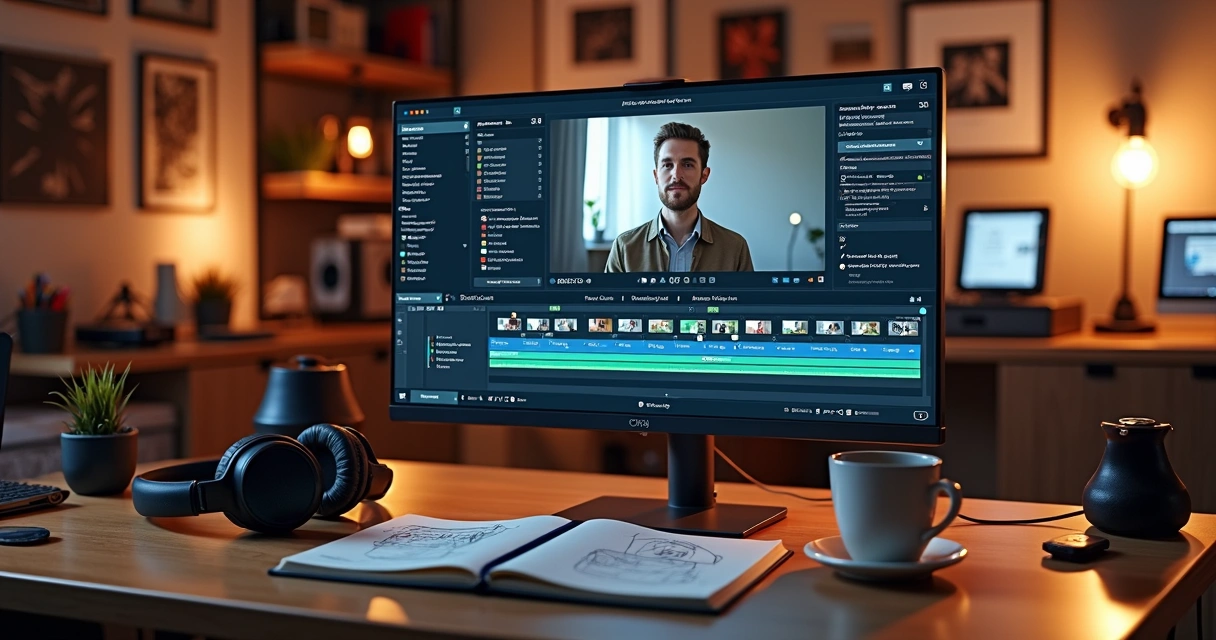 Examples of professional and creative uses of AI Clips
Digital marketing professionals have already adopted AI Clips to boost campaigns, testing different ad versions and increasing brand presence in ever-faster environments. Podcasters, YouTubers, and educators use AI to create trailers, teasers, compilations, or thematic series from raw content.
- Remixes and summaries: A long live stream can yield short thematic cuts, each addressing questions, tips, or funny moments.
- Transformation of formats: Horizontal workshops become vertical Reels; webinars in English are automatically subtitled in Portuguese.
- Content recycling: Old, little-seen videos gain new life in optimized shorts, extending the material’s longevity.
This multiplicity of uses strengthens the strategy of those who produce content on the internet: more experimentation, greater reach, better connection with the audience.
Practical example: how to create AI Clips in a few minutes
The creation process is genuinely accessible for any profile – just have an original video, a stable internet connection, and choose the right platform. A good example is the proposal of the viral clip generator by AI, which prioritizes precision, automation, and personalization.
Here’s a simplified step-by-step:
- Access the platform and log in with your account.
- Select the original video, which can be from 3 minutes to 2 hours. You can also paste a YouTube link.
- Choose subtitle style, format (vertical, horizontal, or square), and language.
- Wait for the AI to process, analyze the content, and automatically suggest multiple clips.
- Visualize the cuts, adjust any details if desired – you can change titles, scene replicas, or subtitle styles.
- Download the ready files and distribute them directly on the social networks of your choice.
All this in less time than it would take to just watch the original video.
Platforms for creating AI Clips: what to expect and choose?
When choosing a reliable solution for AI clips, creativity and automation go hand in hand. But besides that, it’s important to observe details like support for Portuguese, integration with social networks, and advanced options like customizable templates or translation.
VDClip deserves to be highlighted, especially for the Brazilian audience. It is 100% Brazilian, understands our digital culture, offers intelligent automatic curation, intuitive editing, and features like dynamic subtitle generation, translations, and face tracking, in addition to native integration with TikTok, Instagram, and YouTube Shorts.
For those looking for features that go beyond the basics – suggestions for titles and hashtags, scheduling posts, multiple templates, and local experience – the video cutting with AI transforms the way to produce content.
Ethical issues and responsible use of AI Clips
 Ethical issues and responsible use of AI Clips
Just like any powerful technology, AI Clips bring questions about ethics and transparency. The risk of deepfakes, misinformation, or use of images without consent requires responsibility from creators and platforms.
- Watermark: Many systems automatically include watermarks or identification of content generated by AI to facilitate transparency.
- Consent: Platforms recommend using only content owned or for which participants’ permission is obtained.
- Usage guidelines: Serious tools follow data protection norms and provide means for reporting improper use.
- Fake detection: AI-based systems already help identify alterations or undue manipulations in generated videos.
The conscious and transparent use of AI only strengthens the community and increases followers’ trust.
The future of AI Clips: more human, personalized, and integrated
Trends for the coming years point to a scenario of even more creativity and flexibility. It is expected that editing will occur almost in real-time, with dynamic contextual suggestions for trending themes at the moment of creation.
Personalization will also gain strength: clips could have automatic adjustments not just for different platforms but for distinct audiences, taking into account user profile, location, and individual preferences.
All integrated with publication systems, data analysis, and even AI-assisted scripting.
 In the end, AI Clips do not replace the creator but empower ideas, accelerate results, and make the process smoother, more fun, and accessible.
Example of a real workflow: creating your AI Clip on Podcastle by Async
For those who wish to understand the practical details, here’s a summary of the common steps in creating AI Clips in a solution focused on automation and usability:
- Access the tool and log in with your account.
- Add the desired video, whether by uploading directly, pasting a YouTube link, or choosing a file between 3 minutes and 2 hours long.
- Choose the type and style of subtitles (there are dynamic, colorful, minimalist options, among others).
- Wait while AI processes and marks the highlights automatically.
- Visualize the suggested cuts, adjust if necessary (you can change the order, edit subtitles, adapt titles).
- Download the ready clips for use, or publish directly on your preferred social networks.
This workflow eliminates technical barriers and allows anyone to focus on what matters most: creativity and relationship with the audience.
But remember to always seek solutions aligned with your region, language, and business goals. For those looking for a strong option, with support in Portuguese, automation, and local integration, the VDClip automatic clipping system offers differentiators for Brazilians and regional content.
How to create truly relevant viral cuts with AI?
Success in AI Clips goes beyond technology. The best cuts are those that:
- Capture authentic moments (spontaneous reactions, unexpected questions, laughter)
- Present impactful phrases or practical tips in just a few seconds
- Bring visual rhythm: images change, expressions emerge, subtitles highlight each speech
- Include calls or questions stimulating comments and engagement
With AI, all this process that used to take many hours is now done almost instantaneously.
Those who want to create truly good cuts can experiment with video editing using artificial intelligence with VDClip, exploring national templates, local hashtag and title suggestions, as well as perfect adaptation to Portuguese and the Brazilian audience.
Conclusion: The power of AI Clips to transform videos into impact
AI Clips change the logic of content creation. What was once restricted to large teams, trained editors, and significant investment is now accessible to everyone – from individual creators to multinationals.
With artificial intelligence, ideas take shape and reach more quickly, creatively, and democratically. Those who adopt AI Clips, whether for business, entertainment, or education, find an open road to grow on social networks, achieve engagement, and save time without sacrificing quality.
The next step could be yours. If the goal is to stand out with creative and engaging videos, check out VDClip, explore all the features, and start transforming your long videos into viral AI Clips that connect your brand, idea, or project to the world.
Frequently Asked Questions about AI Clips
What are AI Clips?
AI Clips are short and engaging snippets of long videos, automatically created by artificial intelligence platforms, without relying on manual editing. These tools analyze the original material, identify key moments, and deliver ready cuts for social media such as TikTok, Instagram Reels, and YouTube Shorts.
How do AI Clips work?
The operation of AI Clips involves machine learning algorithms, computer vision, and natural language processing. AI scans the entire video, selects highlight moments, transcribes the audio, generates subtitles, adjusts formatting, and even suggests titles and hashtags. This entire process can be completed in a few minutes, with minimal manual intervention.
How do I create my own AI Clips?
To create your own AI Clips, just choose a platform focused on automation, like VDClip. The process involves:
- Logging into an AI clip generator;
- Uploading the original video or inserting the YouTube link;
- Choosing subtitle and cut format options;
- Allowing AI to process and suggest multiple clips;
- Adjusting details, if desired, and downloading the videos ready to post wherever you like.
Is it worth using AI Clips?
Yes, AI Clips save a lot of time, expand creative possibilities, and make content production more accessible for anyone or any business. They help reach a wider audience, maintain frequency on social media, and quickly test different formats without needing video editing experience.
Where can I find the best AI Clips?
The best AI Clips are generated on specialized platforms that offer automatic curation, support for the Portuguese language, and integration with social networks. VDClip is a national reference in this segment, bringing features like automatic cut generation, intelligent subtitles, and formats optimized for the Brazilian audience.