In 2026, short videos continue to gain traction. The audience watches on their phones, switches screens in seconds, and decides quickly whether to stay or leave. In this scenario, two features have become significantly important in the final outcome: AI reframing and automatic subtitles in Portuguese.
AI reframing adjusts the focus of the video for each format without requiring manual cropping frame by frame.
Automatic subtitles transform speech into synchronized text, which enhances understanding, retention, and reach of the content.
Those who produce for social media have already noticed this in practice. An episode of a podcast, a recorded class, or a long interview can yield many clips. But this only works well when the face remains in the center, when movements follow the scene, and when the subtitles appear at the right time. Without this, the video loses impact.
This is why the search for AI-related solutions, video reframing, auto reframing tools, and automatic subtitles in Portuguese has grown between 2025 and 2026. The interest comes not only from editors. It also stems from creators, agencies, companies, cut channels, and marketing teams that need to publish more, with less friction and stable quality.
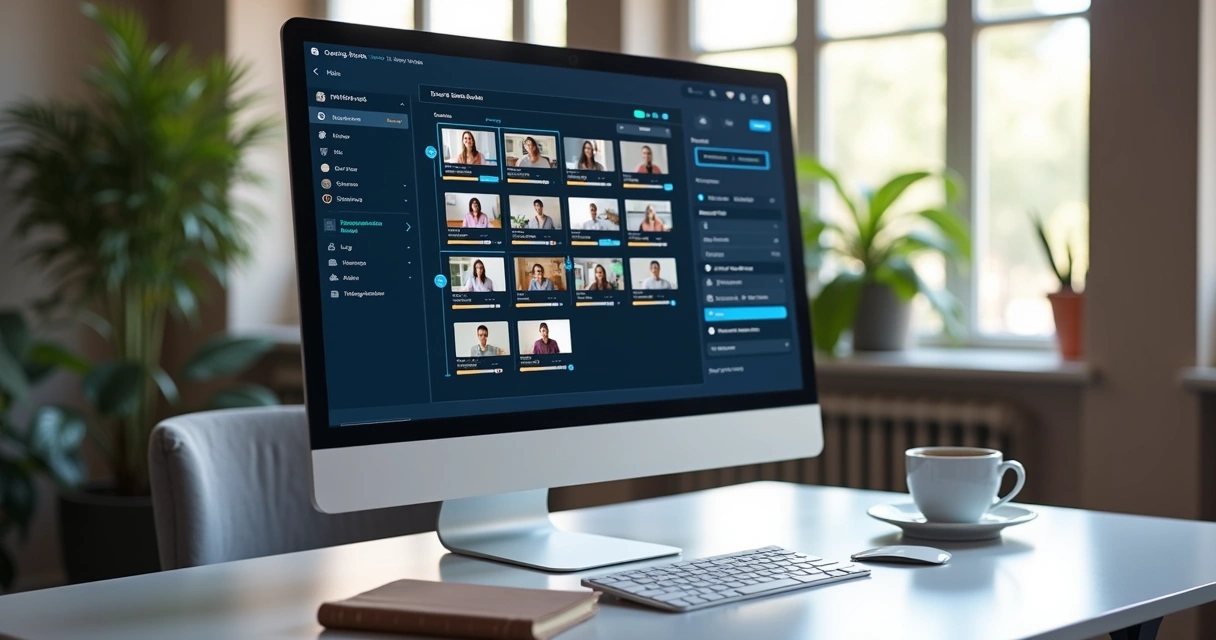
At this point, platforms like VDClip come as a direct answer to a common pain: transforming long material into short, readable, and shareable content. By combining automatic cuts, face tracking, face motion, subtitles, and editing within the platform itself, it reduces steps that previously took hours.
What changed from 2025 to 2026
Until recently, auto reframing was seen as a supporting feature. By 2026, it became part of the production base. It’s no longer enough to resize a horizontal video to vertical. AI needs to understand what matters in the scene.
This includes several signals at once:
- Who is speaking at that moment.
- Where the face is moving.
- Which object deserves attention.
- When there is a change of speaker.
- If the framing should open or close.
The same applies to automatic subtitles. In 2025, many people accepted text with minor errors. By 2026, expectations changed. The audience wants better punctuation, more natural segmentation, and pleasant reading on small screens.
It’s not enough to subtitle. It’s essential to subtitle well.
This change weighs heavily in Brazilian Portuguese, as the language has rhythm, contractions, proper names, and variations in speech that challenge generic models. Therefore, solutions designed for PT-BR are ahead when the goal is to publish quickly without spending time correcting everything later.
How AI reframing actually works
The process seems simple on the surface. The user uploads the video, chooses the format, and receives the finished version. However, inside, the technology works in layers.
The AI analyzes faces, movement, composition, and visual context to decide where to position the crop at every moment.
In practice, the system usually follows a sequence:
- Detects people, faces, and points of interest.
- Identifies who is speaking and when there is a change of focus.
- Calculates the most valuable area of the scene.
- Moves the framing smoothly to avoid jumps.
- Adapts the video to formats like 9:16, 1:1, and 4:5.
When this process is done well, the video appears to have been recorded in the right format from the start. When done poorly, the crop cuts off foreheads, loses gestures, or delays the focus change. It’s the kind of detail that the audience may not name, but they feel.
In an interview cut, for example, the best result doesn’t just depend on centralizing a face. The AI needs to perceive the moment when a silent reaction is worth more than the speech of someone out of frame. This type of reading is what differentiates a common clip from one that captures attention.
In the case of VDClip, this work is enhanced with face tracking and face motion. This helps keep the right person in the center of the action, even when the segment comes from a long video and needs to become a short, reel, or vertical cut in just a few minutes.
Anyone who wants to understand this flow better can see how the automatic video editing with AI works within a proposal aimed at agile publishing.
 What makes automatic subtitles work well
 What makes automatic subtitles work well
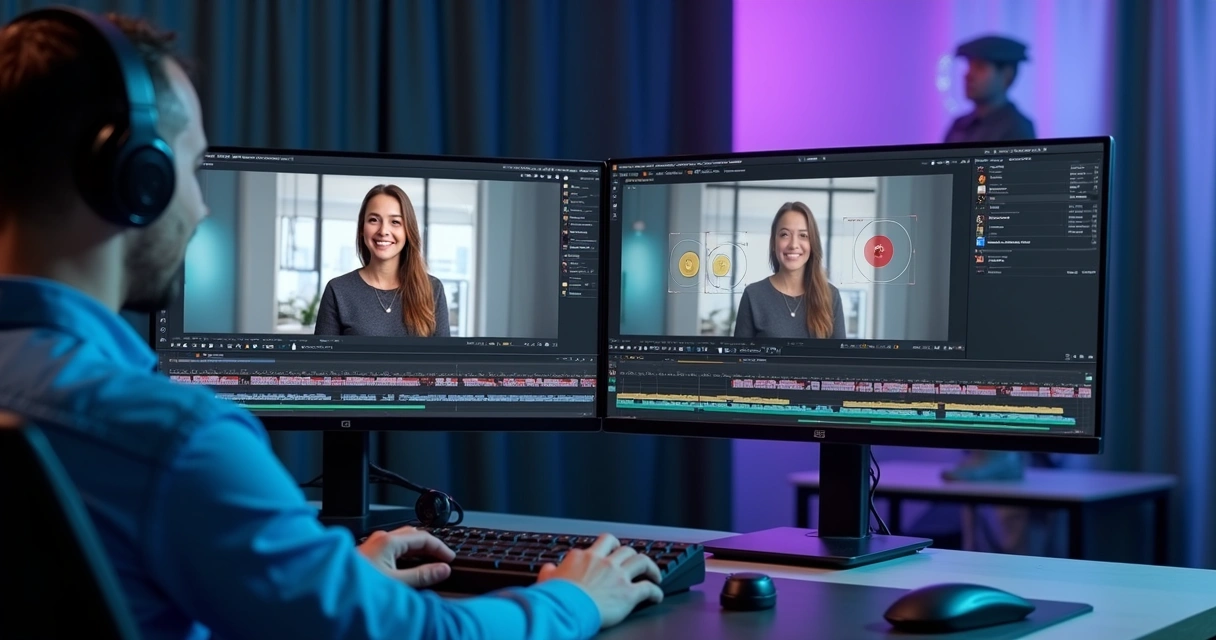
Subtitling is not just about transcribing audio. The system needs to listen, separate voices, understand pauses, mark time, and break sentences in a way that fits on the screen.
A good automatic subtitle depends as much on speech recognition as on how the text is displayed.
In 2026, the best experiences usually combine these points:
- Speech recognition focused on PT-BR.
- Fine synchronization between voice and text.
- Line breaks with rapid reading.
- Punctuation and capitalization correction.
- Visual style adapted to the content.
The last point deserves attention. There are videos where a clean subtitle works better. In others, using highlighted words, emojis, and animation helps the video maintain rhythm. It all depends on the platform, the theme, and the audience profile.
There is also a clear practical effect. Many people watch without sound, in line, on public transport, or at work. The subtitle supports understanding and goes beyond reach. Research related to education shows that subtitling can support language understanding and reading in context, as seen in a study on interlinguistic subtitling and comprehension by Brazilian students.
In the creation environment, this translates into more accessible videos, easier to follow, and stronger in the first seconds. Not surprisingly, the generation of automatic subtitles with AI has become one of the most sought-after resources for frequent publishers.
When long video turns into several short clips
One of the most common scenes in 2026 is simple. A creator records a one-hour conversation. Later, they need to extract ten good segments from it. Previously, this required manual review, time marking, new cuts, frame adjustments, and subtitling item by item.
Now, the AI already takes on a good part of this process.
The automatic curation identifies moments with a higher chance of becoming relevant short clips.
This type of curation observes signals such as:
- Change in tone of voice.
- Pauses before strong phrases.
- Segments with objective responses.
- Moments of visual reaction.
- Blocks with clear beginnings, middles, and ends.
Instead of starting from scratch, the user begins with an already filtered initial selection. This significantly changes the routine for those who post daily. In VDClip, the proposal goes in this direction by combining curation, cuts, and preparation for social media into a single journey. For this type of flow, it makes sense to see how automatic cuts with AI work.
There is also a gain in consistency. When clips are born with similar subtitles, cuts, and visual identity, the profile appears more professional. This matters for brands, agencies, and companies that need to maintain unity without prolonging the process.
Reframing and subtitles go hand in hand
In many cases, the error is not in the crop or in the transcription alone. The problem arises when the two features do not interact. A perfect subtitle can hinder if it rises too high and covers the face. A beautiful reframing can lose value if it makes the text small or outside the reading zone.
The best result appears when framing, text, rhythm, and composition are treated as parts of the same system.
This is where more integrated platforms gain an advantage. The editor does not need to export, open another program, correct the text, return, reframe, and review everything again. Instead, the editing flows in a single line.
In VDClip, this integration also appears in template and brand kit customization. Logo, intro, transition, audio cleaning, b-roll, and emojis can be added without breaking the flow. Then, if the person wants to refine further, there is still a professional editor directly on the platform.
Fewer steps. More consistency.
The role of accessibility in 2026
 The role of accessibility in 2026
Talking about automatic subtitles and AI also requires looking at accessibility. A good video is not just a beautiful video. It’s a video that can be followed by more people in more contexts.
This applies to those who watch without sound, to those who rely more on textual support, and also to those who need clearer descriptions in digital environments. In this field, a research from Univasf on requirements to improve AI in image descriptions for visually impaired people highlights the need for systems more attentive to the experience of people with visual disabilities. Although it deals with image descriptions, the logic applies to audiovisual production in general: good technology is technology that broadens access.
Therefore, the advancement of multilingual subtitles also draws attention. A content recorded in Portuguese can gain versions in other languages without redo the entire process. For brands and creators, this opens up larger distribution paths. For the audience, it means a greater chance of understanding the content in a format that makes sense for their routine.
Practical examples of use
When talking about AI video reframing and automatic subtitles in PT-BR between 2025 and 2026, the gain appears best in real situations. Some examples help.
In the case of a podcast at a table, the long video usually has several people, overlapping speeches, and rapid changes in attention. The system needs to decide who should stay in the center and at what moment. If the subtitle comes in late, the speech loses impact. If the cut is delayed, the reaction fades. A flow with automation reduces this friction.
In recorded classes, the scenario changes. The teacher can walk around, point to the screen, and switch between the camera and visual material. Here, reframing needs to maintain clarity. The subtitle should respect technical terms without breaking sentences in the middle of an idea.
In sales or institutional videos, the focus is usually on the message. The cut needs to look clean, with stable visual identity. The subtitle should reinforce the speech, not compete with it. When there is an integrated editor, the team adjusts details without leaving the platform.
For those who publish frequently, the most direct path is usually to transform long recordings into shorter content. This logic appears well in materials about short videos with artificial intelligence and also in processes to turn long videos into automatic shorts.
What to observe before choosing a solution
Many people are impressed by the promise of automation, but the right choice depends on some practical signs. In 2026, those comparing auto reframing and subtitling tools often observe:
- Quality of reframing in videos with more than one person.
- Performance of subtitles in Brazilian Portuguese.
- Time spent reviewing and adjusting the result.
- Possibility of maintaining brand kit and templates.
- Existence of an internal editor for refinement.
- Publication and scheduling for social media.
A good tool is not the one that makes the most promises, but the one that reduces rework in daily tasks.
This point may seem small, but it changes everything. If the person still needs to correct frame by frame, rewrite half of the subtitle, and export to another environment, automation loses strength. The real value appears when production becomes simpler and more stable.
Why the Brazilian scenario demands adapted solutions
Brazil has its own mix of accents, speech rhythms, and consumption styles. The same content can be born in a corporate webinar, turn into a LinkedIn cut, then a reel, and then a short with a different cover and subtitle. This demands agility but also local reading.
This is where VDClip stands out in the Brazilian scenario of 2026. Instead of being just an editor with loose resources, it was designed for the routine of those who need to cut, reframe, subtitle, customize, and distribute. All of this with an accessible interface for those who do not come from professional editing.
When the tool understands the routine of the Brazilian creator, the process becomes more natural and publishing happens more consistently.
There is also a financial gain. Smaller teams can produce more without increasing reliance on manual processes. For beginner creators, the technical barrier is lower. For agencies, delivery scales better.
Conclusion
 Conclusion
In 2026, AI reframing and automatic subtitles have ceased to be extras. They have become the foundation of rapid, readable video production ready for social media. When these features work together, the video gains rhythm, clarity, and a greater chance of keeping the audience’s attention.
For those dealing with podcasts, interviews, classes, brand videos, or daily content, the best path is to seek a solution that combines segment curation, face tracking, face motion, synchronized subtitles, visual customization, internal editing, and distribution. VDClip meets this need with a Brazilian, straightforward proposal aimed at those who want to transform long videos into short clips without hassle. Those who want to see this flow in practice can access VDClip.com and understand how the platform helps publish more and better.
Frequently Asked Questions
What is video reframing by AI?
Video reframing by AI is the process in which a system identifies faces, movements, and areas of interest to automatically adapt a video to new formats, such as vertical or square. Instead of cropping the image statically, the AI follows the action and repositions the frame throughout the scene.
How do automatic subtitles work in videos?
Automatic subtitles work through speech recognition. The system converts audio to text, marks the time of each segment, and organizes the display on the screen. In more current solutions, the AI also adjusts punctuation, separates sentences, and allows customization of visual style and language.
What are the best reframing tools in 2026?
In 2026, the best tools are those that combine precise reframing, good motion reading, subtitles in PT-BR, simple editing, and low rework. In the Brazilian context, VDClip stands out for bringing together automatic cuts, face tracking, subtitles, template customization, internal editor, and social media posting in one environment.
Is it worth using AI to create subtitles?
Yes, it is worth it, especially for those who publish frequently. AI reduces transcription time, speeds up cut creation, and improves process consistency. There may still be a review in specific cases, but the gain in speed and scale often compensates significantly.
Where can I find automatic subtitle software in PT-BR?
Automatic subtitle software in PT-BR can be found on editing platforms focused on short video and automation. For those looking for a practical solution in Portuguese, with synchronized subtitles, cuts, reframing, and customization in one flow, VDClip is a highly aligned option for the routine of creators, companies, and agencies in Brazil.