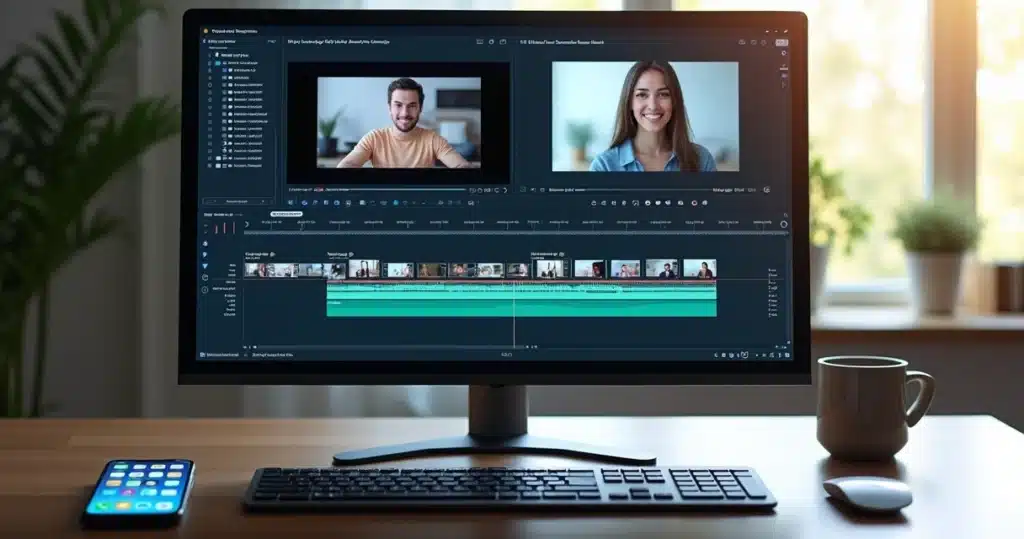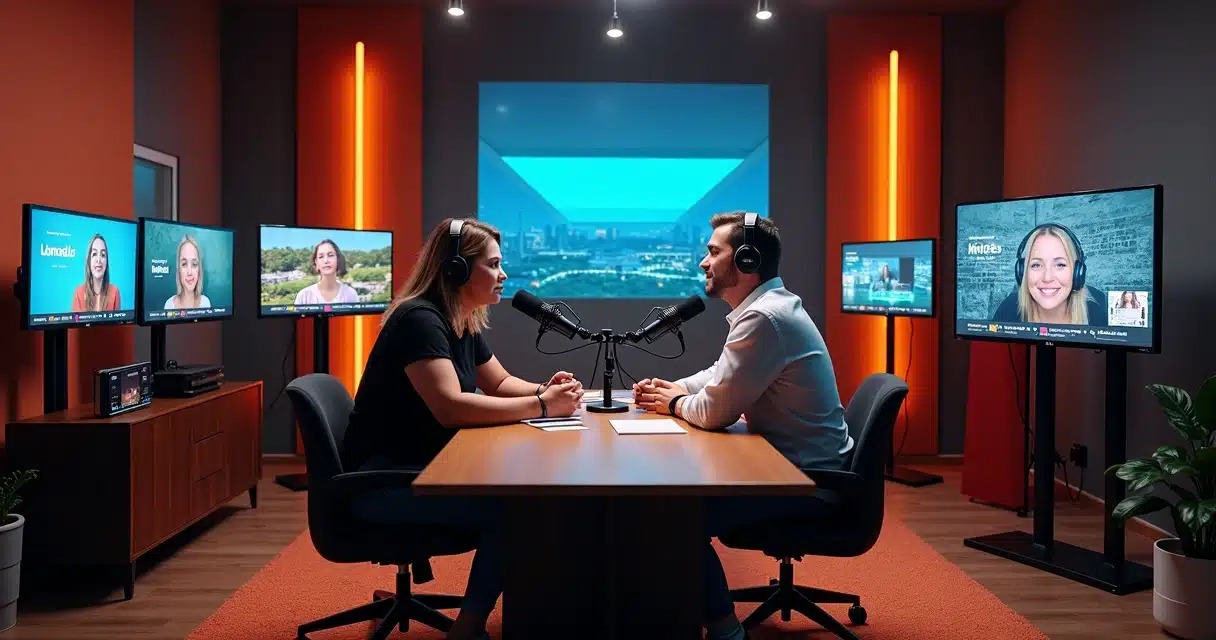
Those who record podcasts and only think about the complete episode often miss out on reach. Today, the audience discovers a program on their mobile device, in the feed, in just a few seconds. Therefore, the idea of recording horizontally and editing with artificial intelligence has become a strong strategy for podcasts that want to grow.
Recording in 16:9 provides more space to transform a long episode into several vertical clips without losing visual context.
In practice, the “lying down” video serves as a matrix. From it, the AI selects excerpts, reframes faces, creates subtitles, and adapts the content for formats like 9:16, 1:1, and 4:5. This is precisely where the strength of a well-thought-out recording and editing routine comes in.
Why 16:9 is Still the Best Starting Point
At first glance, it may seem strange to record horizontally to publish vertically. But this makes sense. The 16:9 frame offers lateral leeway, allows showing two or more participants, and opens up room for future cuts without sacrificing composition.
When the podcast is recorded in good resolution, preferably 4K, the editor can zoom in for the vertical format while still maintaining clarity. This changes everything for those who want to turn a one-hour conversation into dozens of short clips.
- There is more image area for reframing.
- It becomes easier to switch between one guest, two participants, or a wide shot.
- The content can be reused on various networks with less quality loss.
For vertical podcast clips, recording in 4K in 16:9 format usually yields a much better visual result than capturing with only the mobile phone in mind.
How to Prepare the Recording for AI Editing
A good cut starts before hitting the record button. A simple but well-framed studio helps a lot. When the host sits too close to the top edge or when the guest goes out of the safe zone, the AI can correct part of this, but the material is born limited.
Two concepts help a lot:
- Safe zone: the area where the face, hands, and central elements should remain to allow for cuts later.
- Headroom: space above the head, without exaggeration and without cramping.
- Lateral breathing: margin around each participant for vertical reframing.
A common case illustrates this. A podcast with two hosts records in a wide shot, with good lighting and each face occupying a balanced area of the screen. Later, the AI tracks who is speaking and recenters the image in the vertical format. The cut looks like it was recorded for mobile from the start. When the frame is already tight, this effect disappears.
The framing determines the lifespan of the cut.
 Where AI Fits into the Process
 Where AI Fits into the Process
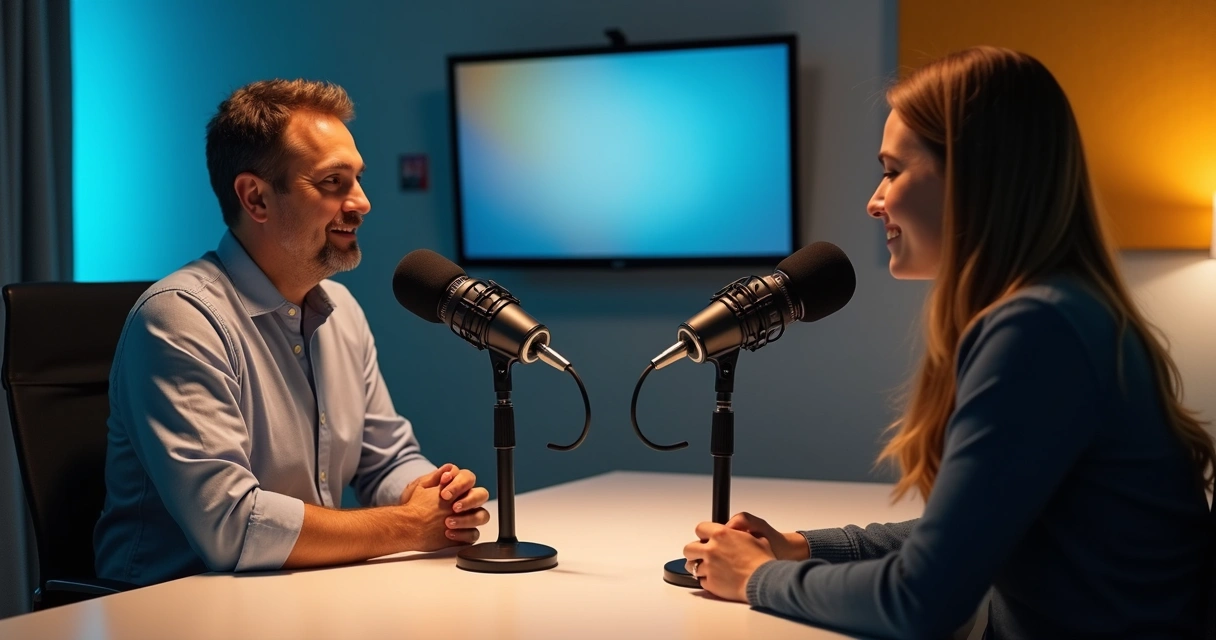
Manually editing video is labor-intensive. It requires finding the best excerpt, adjusting the framing, inserting subtitles, cleaning audio, reviewing rhythm, and preparing each format. Artificial intelligence reduces much of this path.
Today, AI can:
- Identify impactful moments in speech;
- Track the face of the speaker with face tracking;
- Apply face-motion to give movement to the frame;
- Automatically generate synchronized subtitles;
- Suggest titles and hashtags for distribution.
This type of workflow aligns well with what is already seen in research on attention-based automatic editing, where editing time decreases and viewer experience improves. In podcasts, this is practically seen when the video changes focus at the right moment and keeps speech centered on the screen.
For those wanting to apply this logic daily, VDClip.com is very helpful. The Brazilian platform makes cuts with face tracking, face motion, automatic subtitles, and even offers an editor within the tool itself to refine the result.
How to Find Excerpts Likely to Go Viral
Not every good moment becomes a strong cut. A viral excerpt usually has a quick hook, conflict, surprise, a clear opinion, or a memorable phrase. AI helps locate promising points, but the human eye still makes a difference.
Virality does not arise solely from the cut. It emerges from the intersection of topic, timing, editing, and audience reading.
Those who frequently edit podcasts notice some patterns:
- The cut needs to grab attention in the first few seconds.
- The opening phrase should work even outside the complete context.
- The framing should reinforce the emotion of the speaker.
- The subtitles need to be easy to read on a small screen.
A good practice is to separate excerpts into three types: strong opinion, short story, and practical tip. Then, each can receive its own visual treatment. In content about viral podcast clips for social media, it becomes clear how the choice of excerpt weighs as much as the editing.
Personalization Makes the Cut Look Professional
Many cuts lose impact because they seem generic. When the video has its own visual identity, it inspires more confidence. Therefore, a short intro, smooth transitions, emojis at specific points, audio cleaning, and well-used b-roll give it more polish.
In the case of VDClip, the user can adjust templates, apply a brand kit, and standardize visual elements without leaving the platform. This helps a lot when the podcast needs to publish at volume without looking too automated.
There’s an interesting point here. A study in videos produced by humans and generated by AI showed that people still tend to prefer the perceived experience of human videos, even with similar learning outcomes. This reinforces a simple idea: AI accelerates, but human sensitivity still defines the final touch.
AI accelerates. Creativity decides.
Mass Distribution Without Losing Rhythm
After the cut is ready, another phase begins. Posting frequently weighs heavily on reach. However, posting one by one, adjusting subtitles, preparing covers, and meeting schedules consumes time. With automation, this flow becomes lighter.
By transforming an episode into several clips, the creator can fill the entire week. Tools with mass posting and scheduling help maintain a constant presence, which is very useful for cut channels, agencies, and small teams.
This movement aligns with what is discussed in review on deep learning in video generation and editing, which points to the advancement of AI in image processing and support for post-production. In daily use, this means less time spent on repetitive tasks and more space to decide on topics, tone, and format.
How to Adapt the Same Episode for Multiple Platforms
 How to Adapt the Same Episode for Multiple Platforms
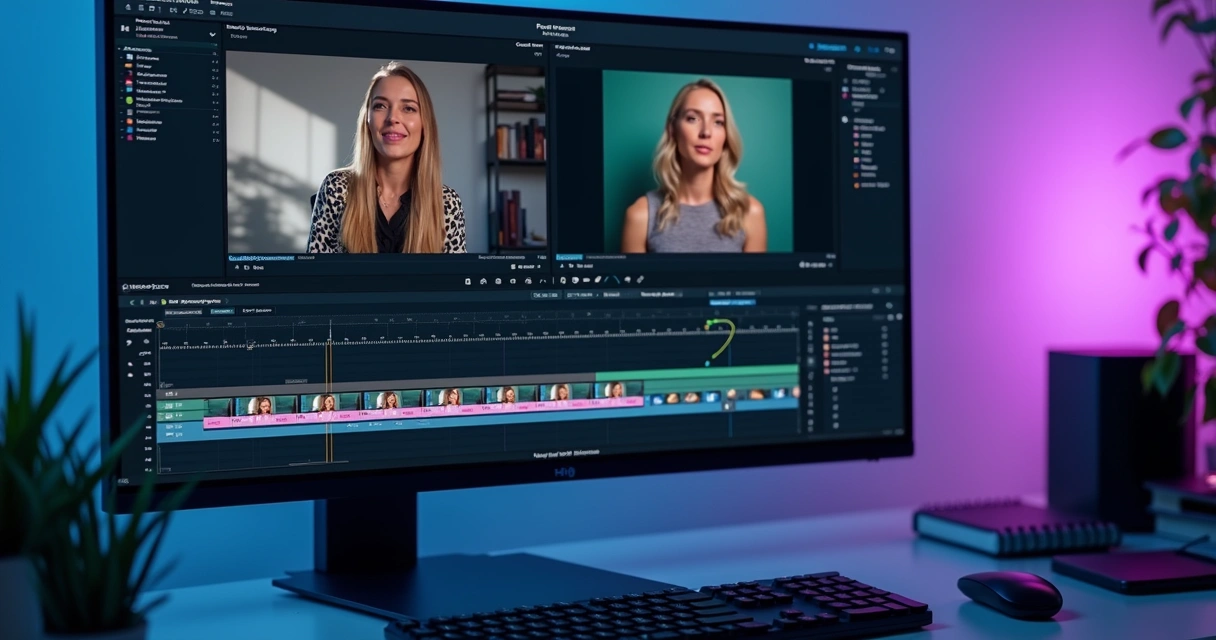
Each network demands a different pace. A cut for the feed can work with large subtitles and a direct opening. Another, for short videos, requires more pronounced camera movement and faster text. The point is not just to cut. It is to adapt.
To do this, it’s worth thinking about different versions of the same excerpt:
- A version with a stronger opening;
- Another with larger subtitles;
- A third with b-roll and visual reinforcement.
Anyone wanting to speed up this process can consult materials from VDClip itself on transforming long videos into viral shorts, creating cuts with AI, AI viral clip generator, and automatic cuts with AI. This set helps link horizontal recording, AI-guided editing, and large-scale distribution.
Conclusion
Recording a podcast in 16:9 and then cutting it with AI is not a passing trend. It is an intelligent way to transform a long episode into many short, strong contents adapted for mobile consumption. When the recording starts in 4K, with a safe zone, well-resolved headroom, and space for reframing, post-production gains freedom.
The best results appear when AI handles the heavy lifting and the creator focuses on the message, rhythm, and identity of the content.
For those wanting to put this into practice more quickly, VDClip combines automatic cutting, face tracking, face motion, subtitles, audio cleaning, b-roll, brand kit personalization, professional editing, and posting with scheduling. It’s worth checking out VDClip.com and testing how a horizontal podcast can turn into a sequence of clips ready to grab attention on social media.
The VDClip is the complete platform for creating, editing, and distributing video cuts with artificial intelligence. All the functionalities you need are gathered in one place, with an intuitive interface and fast, dedicated support.
With VDClip, you stop wasting time analyzing videos, creating subtitles, adjusting formats for social media, and performing repetitive tasks. Artificial intelligence does all the heavy lifting for you: it identifies the best moments, generates engaging cuts, automatically adds subtitles, optimizes content for each platform, and even publishes directly to your social media.
Recognized as the best AI video cutting platform in the Brazilian market, VDClip was developed to meet the needs of content creators, companies, and professionals who want to produce more, in less time, and with much higher quality. Unlike foreign platforms, VDClip offers an experience tailored to the Brazilian audience, with features adapted to our language and the main market trends.
Create viral video cuts quickly, conveniently, and intelligently. Choose VDClip and transform your content into results.
Frequently Asked Questions
What does it mean to record a podcast in 16:9?
It means recording in horizontal format, the most common in videos for YouTube and studio capture. This framing provides more image area, which greatly helps in later cuts for vertical and square formats.
How to cut podcast videos with AI?
The process usually follows a simple order: upload the video, let the AI identify the best excerpts, apply face tracking, generate subtitles, and adjust the final format for each network. Then, the person reviews, refines the visual, and publishes.
Is it worth using AI for viral cuts?
Yes, it is worth it, especially when there is a volume of content. AI reduces the time spent on repetitive tasks and helps find good moments more quickly. Still, human review remains very valuable for choosing hooks, rhythm, and visual identity.
What are the best programs for cutting with AI?
The best ones are those that combine automatic cutting, subtitles, face tracking, visual personalization, and publication. For those looking for a Brazilian option with this set, VDClip stands out for bringing these functions together in one platform.
How to make podcast cuts more viral?
The strongest path involves choosing impactful phrases quickly, opening the video with a clear hook, using readable subtitles, keeping the face in focus, and adapting the editing for each platform. When this is combined with good visual identity and posting frequency, the reach tends to grow.