In 2026, the logic of short video production changed. The routine that previously depended on an exclusive editor to cut speeches, fit captions, adjust framing, and publish across multiple networks is now handled by AI systems that take care of almost everything. What was once a slow flow has become a direct process, with the selection of the best moments, repurposing of content, and scheduling in just a few steps.
The exclusive shorts editor is no longer a requirement when AI began to handle not just the cuts, but the entire content operation.
This scenario did not appear by chance. The audience has increased its consumption of short videos, teams have become leaner, and the demand for consistency has grown. At the same time, AI tools for automatic editing of short videos have matured. They began to understand rhythm, pause, faces, captions, context, and the format of each platform.
It was at this point that platforms like VDClip gained real traction. Instead of acting solely as a cutting editor, it began to function as a system for analysis, auto clipping, visual customization, and distribution. Those who work with podcasts, interviews, classes, reviews, corporate content, or cut channels quickly noticed the difference.
It’s not enough to cut. You need to publish intelligently.
What Really Changed in 2026
For many years, the reasoning was simple: long video recorded, editor receives the material, looks for good excerpts, assembles some shorts, and returns it. This process still works, but it no longer makes sense as a rule. In 2026, the demand became broader. It’s not just a nice cut that is requested. There’s a demand for scale, consistency, visual identity, and speed.
The market began to value less repetitive labor and more the ability to transform a long piece into multiple ready-to-publish assets.
There is also a cultural shift. Research by the Itaú Foundation in partnership with Datafolha showed that 93% of respondents already use some AI tool, and 31% use image or video generation. This shows that audiovisual automation has ceased to be a curiosity and has entered the routine.
Among the younger audience, the adaptation is even earlier. The report from Cetic.br on the use of generative AI among children and adolescents revealed massive adoption for studying and creating content. When the next generation is born producing with the support of AI, the idea of relying solely on manual editing becomes even more distant.
This helps to understand why an exclusive shorts editor, isolated from the rest of the process, has lost value. The bottleneck is no longer just in the cutting. It is in the entire flow.
The Problem with the Old Model
The old model brings some clear limits. At first glance, it seems secure. There’s someone looking at every second of the video, selecting impactful phrases, and assembling the material. But when the volume grows, hidden costs appear.
Among the most common problems are:
- Dependence on one person for repetitive tasks.
- Delay in locating the best moments in long videos.
- Difficulty maintaining visual standards at scale.
- Low posting frequency due to lack of time.
- Rework when adapting the same content for different networks.
- Lack of integration between editing, title, hashtag, and publication.
In a small operation, this already weighs. In an operation with multiple clients, episodes, interviews, or classes, it weighs much more. The exclusive editor ceases to be a solution and becomes part of the bottleneck.
When each cut depends on manual work from start to finish, consistency becomes a problem of cost and time.
It is at this point that automation ceases to be an extra resource and becomes the center of the strategy.
How AI Began to Do More Than Just Cut
The AI tools for short videos in 2026 are no longer limited to detecting pauses or audio peaks. They observe broader signals. A section with strong verbal retention, a change in tone, visual reactions, closed arguments, or a phrase with sharing potential tends to be identified as a priority.
Instead of a simple digital scissor, AI has become a context reading system. It performs auto clipping, organizes the best moments, and prepares the piece with characteristics suitable for social media.
In the case of VDClip, this process takes practical form with features such as:
- Automatic selection of the most relevant excerpts.
- Generation of cuts with face tracking and face motion.
- Captions synchronized with adjustable visual style.
- Audio cleaning and insertion of elements like emojis and b-roll.
- Templates with brand kit, logo, intro, and transitions.
- Suggestions for titles, descriptions, and hashtags.
- Internal professional editor for final refinement.
- Mass posting and scheduling directly on the networks.
In 2026, the best automation doesn’t just cut excerpts. It delivers pieces almost ready for distribution.
This changes the conversation. It’s no longer just about who edits better. It’s about who can transform a long video into a machine for recurring content.
 Content repurposing has become a real advantage
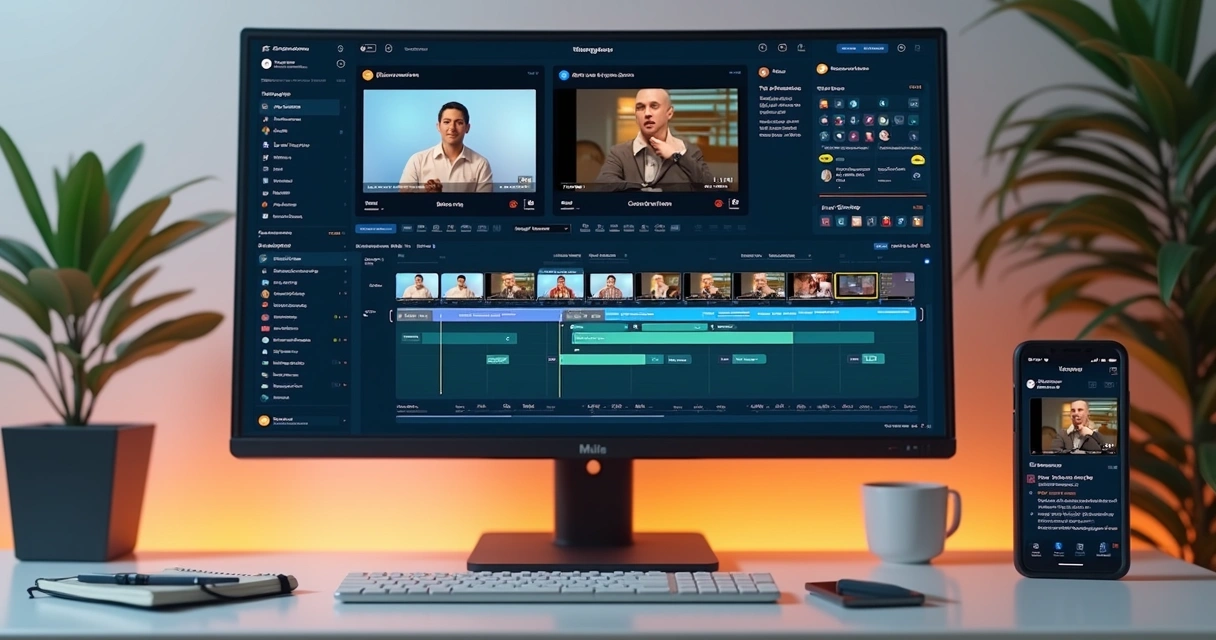 Content repurposing has become a real advantage
Those who record podcasts have already understood this. Those who record meetings with specialists, classes, training sessions, interviews, or webinars also have. A long video can yield dozens of contents. The problem, until recently, was operationalizing this idea without stalling the team.
Repurposing content has ceased to be a secondary plan and has become one of the fastest ways to grow without recording more.
A 60-minute episode can turn into:
- 8 to 20 shorts with different hooks.
- Versions with visual styles adapted for different platforms.
- Thematic clips by subject, question, or objection.
- Materials with multilingual captions to broaden reach.
- Posts distributed over weeks through scheduling.
This logic aligns with what the market itself seeks when researching auto clipping, best moments, content repurposing, and scheduling. The interest is no longer just in editing. It’s about building a flow that continues generating results after recording ends.
For those who want to understand this process better, the content about transforming long videos into automatic shorts helps visualize how the operation can shift from manual to scalable.
Has the human editor disappeared?
No. What has disappeared is the need for an exclusive editor for tasks that AI already handles well. There is a big difference between high-level creative work and repetitive mass production work.
The human touch remains useful in special campaigns, positioning videos, pieces with very specific language, or fine narrative adjustments. However, this no longer requires a person dedicated exclusively to the daily shorts.
AI has not eliminated the human touch. It has removed humans from the tedious and repetitive parts of the process.
This point often brings relief to small teams. Instead of spending hours marking cuts, centralizing speeches, and reviewing caption by caption, the team works from a ready base. The professional steps in to approve, adjust, and publish, not to build everything from scratch.
It was this transition that made platforms like VDClip more attractive in 2026. The user does not have to choose between automation and control. They get both.
Where VDClip Fits into This Scenario
VDClip fits exactly into the new moment of automatic video editing with AI. It is not limited to the role of a simple cutter of excerpts. It acts as a complete platform for those who want to produce consistently without relying on an exclusive editor for each step.
Upon receiving a long video, the system can locate the best moments, generate vertical cuts, insert dynamic captions, track the face of the person on screen, and maintain visual focus with face motion. After that, there is still room for customization in the internal editor.
This detail changes the experience. Automation takes care of the heavy lifting, but refinement is still available. This caters to both those who want total speed and those who wish to adjust color, timing, transitions, logo, intro, or b-roll.
In many cases, the biggest pain is not editing a video. It’s editing fifty. That’s where a platform like VDClip makes direct sense.
Those wishing to delve deeper into the topic can see how automatic video editing with AI works in a flow designed for creators, companies, and scalable content operations.
Time, cost, quality, and consistency
 Time, cost, quality, and consistency
These four factors define almost every content decision in 2026. The problem is that the manual model rarely delivers all four at the same time. When quality rises, time increases. When costs drop, consistency suffers. When consistency increases, visual standards start to falter.
With AI, this balance changes.
In terms of time, the automatic selection of the best excerpts reduces hours of searching. In terms of cost, it decreases the need for a professional tied to mechanical tasks. In terms of quality, the visual standard becomes more stable with templates and a brand kit. In terms of consistency, mass scheduling prevents good clips from sitting idle in a folder.
The real value of automation lies in transforming raw volume into publication frequency with a visual standard.
A simple story helps to see this. A small podcast studio records two interviews a week. Previously, it spent days waiting for manual cuts. At various points, episodes aged before even yielding good clips. With a system like VDClip, the sorting of the best moments happens right after upload. The team’s editor only steps in to adjust details. The calendar is already filled. The feeling changes quickly.
Instead of chasing content, the content begins to work for itself.
Scheduling Has Ceased to Be a Detail
In many old workflows, the video was edited and ready. The publication was left for later. In 2026, that is no longer enough. Producing without scheduling keeps part of the problem alive. The team remains hostage to manual execution, loses timing, and becomes more prone to errors.
Editing without scheduling is completing only half the job.
Tools aimed at short videos evolved because they understood this. The ideal journey now includes preparing the material for distribution and bulk posting. This point is very strong in VDClip, as the platform allows not only creating the cuts but also organizing and scheduling posts directly on the networks.
This resolves a recurring pain for agencies, solo creators, and internal marketing teams. Instead of opening multiple tabs, uploading one video at a time, and hastily writing captions, the material follows a single flow.
For those experiencing this difficulty, the text on how to post videos without an editor shows why automated publishing has gained so much traction.
Personalization Still Matters a Lot
Some people still associate automation with generic content. In 2026, this perspective has aged. The best platforms do not deliver just one cut equal for everyone. They provide structure to adapt the result to the brand’s style.
In VDClip, this appears in the use of customizable templates, brand kits, logos, intros, transitions, audio cleaning, automatic emojis, b-roll, and a professional editor within the interface. The cut is born from AI, but the finishing can follow the identity of each project.
Good automation does not erase the brand’s identity. It standardizes the base and opens up space for rapid personalization.
This factor matters a lot for companies that need to publish without appearing improvised. It also helps creators who want to maintain a visual signature without spending time repeating the same process.
Those following industry changes may notice this in the short video trends in 2026, which point to a clear mix of automation, visual adaptation, and context-driven distribution.
When Hiring an Exclusive Editor No Longer Makes Sense
 When Hiring an Exclusive Editor No Longer Makes Sense
There are situations where the math simply doesn’t add up anymore. This happens when most of the routine involves activities that a good AI can execute in minutes. Looking for strong phrases, cutting silences, repositioning faces on screen, captioning, applying templates, suggesting titles, and organizing posting no longer needs to occupy the time of a professional dedicated exclusively to that.
It makes less sense to keep an exclusive editor when:
- The volume of long videos is high and recurring;
- The goal depends on weekly or daily consistency;
- There’s a need to repurpose the same material in various formats;
- The team is small and needs to scale;
- The budget requires more predictability;
- The brand needs to publish with visual standards without stalling operations.
In these cases, a platform like VDClip.com tends to deliver better cost and more operational fluidity than a process focused solely on manual editing.
For those producing shorts frequently, it’s also worth checking out the proposal from the YouTube Shorts creator with automatic editing by AI, which effectively translates this transition from repetitive artisanal work to a continuous system.
Conclusion
In 2026, the exclusive shorts editor does not disappear due to a lack of talent. It becomes dispensable because the center of the operation has changed. The market now demands cutting, captioning, face tracking, visual identity, best moments, content repurposing, and scheduling in the same flow.
Those who still treat short videos as an isolated task are operating with the logic of the past.
The new advantage lies in uniting AI, consistency, and publication. Platforms like VDClip clearly show this shift. They are not just for editing. They are for transforming a long video into a sequence of ready-to-circulate assets, with less time wasted, lower costs tied to operations, and more presence on social media.
If the goal is to produce at scale and maintain quality without relying on an exclusive editor for each cut, it’s worth exploring how https://vdclip.com integrates creation, refinement, and scheduling into a single routine.
Frequently Asked Questions
What are AI tools for short videos?
They are platforms that use artificial intelligence to transform long videos into short clips ready for social media. They can locate the best moments, cut excerpts, generate captions, adjust framing, apply templates, and even suggest titles and hashtags. In 2026, these tools have ceased to be simple editors and have begun to act as complete production systems.
How to choose the best automatic editor in 2026?
The choice depends on some practical points: quality of automatic selection, accuracy in captions, face tracking features, visual personalization options, internal editor for adjustments, and posting with scheduling. Ease of use also matters a lot. When the platform combines all of this in one place, it tends to reduce steps and rework.
Is it worth using AI for best moments?
Yes, especially when there is a large volume of material. AI can identify strong speeches, excerpts of greater impact, and cuts with a chance of good performance. This speeds up the sorting process and reduces the time spent watching long videos from beginning to end. For podcasts, classes, interviews, and recurring content, the automatic selection of the best moments has already become a very logical choice.
Where to find the best automatic editing tools?
The best way is to look for platforms that combine automatic editing, content repurposing, and scheduling within the same structure. In this context, VDClip stands out for bringing together AI analysis, captions, face motion, brand kit, professional editor, and mass posting. For those who want to apply this in practice, access to VDClip.com is a good starting point.
How to schedule posts of repurposed videos?
After transforming a long video into several short clips, the simplest way is to use a platform that allows organizing everything in bulk. Ideally, you should define titles, hashtags, format, and publication dates in the same flow as the editing. When scheduling is part of the tool itself, repurposing content becomes more regular and easier to maintain over the weeks.